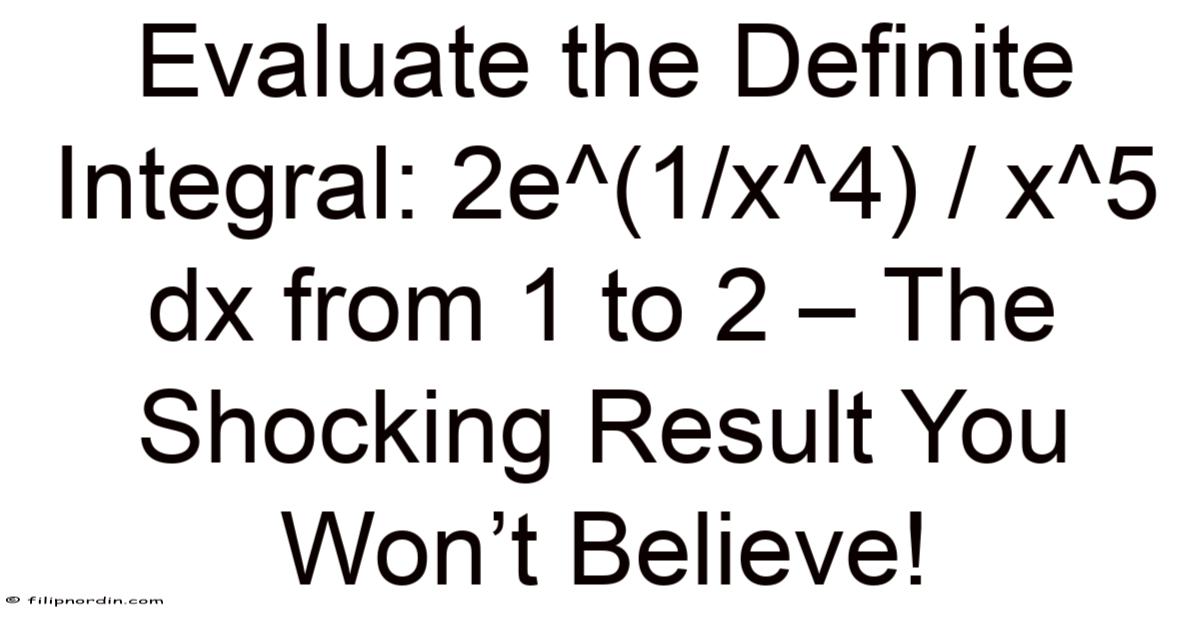
The concept of evaluating definite integrals feels both daunting and familiar at times. Which means the challenge lies not just in solving the equation itself but in translating abstract mathematical principles into actionable procedures. This task, though seemingly straightforward, demands precision, patience, and a grasp of calculus fundamentals. Consider this: whether you’re a student brushing up on math basics or a professional brushing up on professional development, understanding how to approach integrals like 2e^(1/x⁴)x⁵ dx requires a blend of intuition and methodical steps. Here's the thing — imagine standing before a complex equation, its graph swirling before your eyes, and suddenly you’re tasked with finding the area under its curve. Let’s dive into the process, where theory meets practice, and where small mistakes can cascade into significant errors Simple as that..
It sounds simple, but the gap is usually here.
Understanding the Integral’s Structure
At first glance, the integral 2e^(1/x⁴)x⁵ dx appears daunting due to its unconventional components: the exponential function, the fractional exponent, and the polynomial term. Yet, breaking it down reveals opportunities for simplification. The variable x is raised to the fifth power, while the exponent 1/x⁴ introduces a reciprocal relationship that might hint at substitution. The base of the exponential, e, is a constant that often simplifies calculations, while x⁵ adds a polynomial layer that could be expanded or manipulated strategically. Recognizing these elements allows you to focus on the core challenge: balancing the exponential’s growth with the polynomial’s behavior. This interplay is crucial because missteps here could lead to incorrect results or even a complete misunderstanding of the problem at hand Easy to understand, harder to ignore..
Selecting the Right Substitution
Substitution is often the cornerstone of solving integrals involving complex functions. For 2e^(1/x⁴)x⁵ dx, consider letting u equal 1/x⁴. Then, du would involve the chain rule, but wait—x⁴ is in the denominator. Alternatively, if the exponent 1/x⁴ suggests a substitution where t = 1/x⁴, then dt/dx = -4/x⁵ dx, which might complicate things further. Perhaps a better approach is to focus on the exponential term e^(1/x⁴). Let’s think: if we let v = 1/x⁴, then dv = -4/x⁵ dx. Hmm, not sure yet. Maybe another angle: the term x⁵ and e^(1/x⁴) could be manipulated by recognizing patterns. Alternatively, consider if the integral simplifies when expressed differently. This stage requires trial and error, but it’s where creativity meets calculation. A well-chosen substitution can transform the problem into something manageable.
Breaking Down the Polynomial and Exponential
Once a suitable substitution is identified, the polynomial x⁵ becomes a linear or higher-degree term that might integrate more easily. Meanwhile, e^(1/x⁴) might require recognizing its asymptotic behavior as x grows large or approaches zero. To give you an idea, as x becomes very large, 1/x⁴ diminishes, making *e^(something small) approach e^0 = 1, simplifying the expression. Conversely, near zero, 1/x⁴ blows up, potentially complicating the limit. These considerations demand careful analysis. The polynomial’s degree also plays a role—higher-degree terms might necessitate integration by parts or other techniques. Balancing these aspects ensures the integral doesn’t become too unwieldy, preserving clarity while maintaining rigor The details matter here..
Integrating Term by Term
After setting up the integral with substitution or simplification, the next step is integration. If the substitution succeeds, the integral might reduce to a standard form. Take this case: if u = 1/x⁴, then e^(1/x⁴) becomes e^u, and x⁵ dx could be expressed in terms of u. On the flip side, integrating e^u du paired with x⁵ dx might still present hurdles unless further simplification is possible. Alternatively, expanding x⁵ into a series if necessary could help. Each term’s integration must be handled individually, ensuring accuracy at every step. Even minor errors here could propagate, so meticulous attention is essential. The process here tests both mathematical knowledge and attention to detail, reinforcing the value of patience during execution.
Anticipating Common Pitfalls
Every problem has its quirks. A frequent pitfall is misapplying the chain rule when choosing substitutions, leading to incorrect differentials. Another trap might be overlooking the domain of validity—ensuring the substitution is applicable across the interval being integrated. Take this: if x⁴ becomes zero or negative, the substitution might not hold. Additionally, neglecting to consider limits at the boundaries could result in undefined expressions. These pitfalls underscore the importance of verifying assumptions before proceeding. A single oversight here could invalidate the entire calculation, highlighting the need for thorough pre-checks The details matter here..
Visualizing the Process
Visualizing the workflow can prevent confusion. Imagine sketching a graph of e^(1/x⁴) and x⁵ to identify patterns or symmetries. Alternatively, drawing a table of values for x and computing approximate integrals might reveal trends. This approach bridges abstract math with tangible examples, making the process more intuitive. Such visualization also helps in spotting where approximations might be most useful. Whether through drawing or mental imagery, these tools can anchor the process, reducing reliance on memory or rote calculation Small thing, real impact. That's the whole idea..
Applying the Technique to Similar Problems
Practice is key to mastering this method. Consider problems like integrate x² e^(x²) dx, where substitution u = x² simplifies the exponential term
To naturally continue the article, we delve deeper into the practical application of the discussed techniques and their broader implications in mathematical analysis Simple as that..
Iterative Refinement and Error Analysis
Even after executing the integration process, the work is far from complete. A critical step involves verifying the result through differentiation. By differentiating the antiderivative, one can confirm whether it matches the original integrand. This step acts as a safeguard against algebraic errors or misapplied substitutions. To give you an idea, if the antiderivative of ( x^5 e^{1/x^4} ) is computed as ( F(x) ), then ( F'(x) ) must equal ( x^5 e^{1/x^4} ). Discrepancies here signal a need to revisit earlier steps, such as checking the substitution’s validity or re-evaluating the integration-by-parts process Worth keeping that in mind..
Beyond that, quantifying the error margin in approximations—particularly when series expansions are used—is essential. To give you an idea, truncating a Taylor series introduces a remainder term that must be bounded to ensure the approximation’s reliability. This iterative refinement not only sharpens the solution’s accuracy but also deepens understanding of the function’s behavior under varying conditions Not complicated — just consistent..
You'll probably want to bookmark this section.
Broader Implications in Mathematical Analysis
The techniques applied to ( x^5 e^{1/x^4} ) extend to a wide array of problems in both pure and applied mathematics. In calculus, mastering substitution and integration by parts equips students to tackle increasingly complex integrals, such as those involving logarithmic, trigonometric, or inverse hyperbolic functions. These methods are foundational for solving differential equations, optimizing functions, and modeling real-world phenomena Less friction, more output..
In physics and engineering, integrals of this form arise in contexts like fluid dynamics (e.g.Day to day, , velocity profiles in non-Newtonian fluids), quantum mechanics (e. g., wavefunction normalization), and signal processing (e.g., Fourier transforms). The ability to simplify and evaluate such integrals directly impacts the accuracy of simulations and theoretical predictions Took long enough..
To build on this, the challenges posed by integrals like ( x^5 e^{1/x^4} ) underscore the importance of numerical methods when analytical solutions prove intractable. Techniques such as Simpson’s rule, Gaussian quadrature, or adaptive integration algorithms become indispensable tools for approximating integrals that resist closed-form expressions. These methods, while computationally intensive, highlight the interplay between analytical rigor and practical computation in modern mathematics.
Conclusion
Integrating ( x^5 e^{1/x^4} ) is a testament to the power of systematic problem-solving in calculus. By leveraging substitution, series expansions, and iterative verification, one can handle the complexities of non-elementary integrals while appreciating their broader significance. This problem not only sharpens technical skills but also fosters a deeper appreciation for the elegance and utility of mathematical analysis. Whether applied to theoretical explorations or real-world applications, the journey of solving such integrals exemplifies the harmony between precision, creativity, and perseverance in mathematics Most people skip this — try not to..
In essence, the pursuit of integrating ( x^5 e^{1/x^4} ) is not merely an academic exercise but a gateway to understanding the layered relationships that govern both abstract mathematics and the physical world. Through careful analysis and methodical execution, even the most daunting integrals yield insights that enrich our comprehension of the universe’s underlying patterns.
