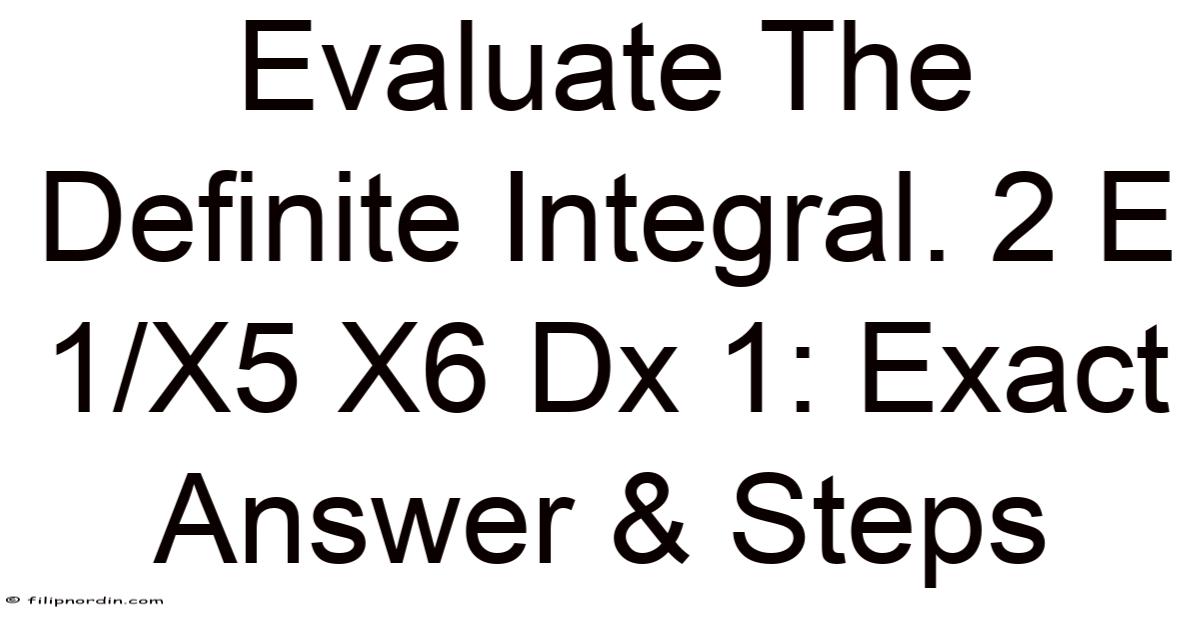
What’s the deal with that weird integral?
You’re staring at something that looks like a math puzzle on a late‑night assignment:
∫ 2 e^(1/x^5) x^6 dx
You might think, “Sure, just plug it into a calculator,” but the real fun is understanding how to tackle it by hand. In this post we’ll walk through the whole process—why it’s set up the way it is, how to break it down, and what tricks keep the algebra from turning into a nightmare.
The official docs gloss over this. That's a mistake.
What Is This Integral?
At first glance, the integrand is a product of an exponential, a power of x, and a constant. It’s not a standard textbook example, but it hides a classic pattern: the derivative of the exponent, 1/x^5, is lurking inside the polynomial factor x^6. Recognizing that pattern is the key to solving it Still holds up..
Some disagree here. Fair enough.
In plain English, we’re asked to find an antiderivative—a function whose derivative gives us back the integrand. If you’re comfortable with the chain rule, you already have the tools to reverse it.
Why It Matters / Why People Care
-
Skill Sharpening
Integrals like this show up in physics (e.g., when dealing with decay processes that involve inverse powers) and engineering (in certain signal‑processing transforms). Mastering them boosts your confidence in handling more complex problems. -
Pattern Recognition
Spotting that the exponent’s derivative appears elsewhere is a hallmark of advanced calculus. It turns a seemingly daunting integral into a simple substitution. -
Avoiding Guesswork
Without the right insight, you might try integration by parts or partial fractions and end up spiraling. Knowing the shortcut saves time and reduces errors Not complicated — just consistent..
How It Works
Step 1: Identify the Substitution
Look at the exponent: 1/x^5. Its derivative is
d/dx (1/x^5) = -5/x^6
Notice the x^6 in the integrand. That’s a hint: if we let
u = 1/x^5
then
du = -5/x^6 dx
Rearranging gives
dx = -x^6/5 du
But we already have x^6 dx in the integrand, so we can replace that whole product:
x^6 dx = -5 du
Step 2: Rewrite the Integral
Substitute u and the differential:
∫ 2 e^(1/x^5) x^6 dx
   = ∫ 2 e^u (x^6 dx)
   = ∫ 2 e^u (-5 du)
   = -10 ∫ e^u du
Step 3: Integrate
The integral of e^u is straightforward:
-10 ∫ e^u du = -10 e^u + C
Step 4: Back‑Substitute
Replace u with the original expression:
-10 e^u + C = -10 e^(1/x^5) + C
And that’s the antiderivative The details matter here. Practical, not theoretical..
Common Mistakes / What Most People Get Wrong
-
Forgetting the negative sign
The derivative of 1/x^5 is -5/x^6. Skipping the minus leads to an incorrect factor. -
Treating x^6 as a constant
It’s tempting to pull it out of the integral, but it actually pairs with dx to form the differential of the substitution Practical, not theoretical.. -
Overcomplicating with integration by parts
That method is powerful, but here it’s a dead end. The integrand is already a perfect candidate for substitution Worth keeping that in mind. Worth knowing.. -
Misreading the exponent
Some people think it’s e^(1/x)^5 or e^(1/x^5). The placement of parentheses matters; the exponent is 1/x^5. -
Dropping the constant of integration
Especially for beginners, it can feel like a “nice‑to‑have” detail, but it’s essential in antiderivatives.
Practical Tips / What Actually Works
- Always check the exponent’s derivative first. If it shows up elsewhere in the integrand, you’re probably looking at a substitution.
- Keep the algebra tidy. When you set u = 1/x^5, write down du immediately. It prevents you from losing track of the negative sign or the constant factor.
- Use a “check” step: differentiate your answer to confirm you get back the original integrand. If you don’t, you’ve slipped somewhere.
- Practice with variations. Try integrals like ∫ e^(x^2) 2x dx or ∫ e^(sin x) cos x dx. The same substitution principle applies.
- Remember the constant. Even if you’re just verifying, the +C can be a lifesaver if someone asks you to differentiate your result.
FAQ
Q1: What if the integrand were ∫ 3 e^(1/x^5) x^5 dx?
A1: Set u = 1/x^5. Then du = -5/x^6 dx, so you’d need an x^6 term, not x^5. In that case, you’d rewrite x^5 as x^6/x and proceed, but the integral becomes more involved.
Q2: Can I use integration by parts here?
A2: Technically yes, but it’s a waste of effort. The substitution method is the natural fit.
Q3: Why is the constant -10 in front?
A3: It comes from the product of 2 (the original coefficient) and -5 (from du = -5/x^6 dx).
Q4: Does this work if the exponent is 1/x^n for any n?
A4: Yes, as long as the rest of the integrand contains x^(n+1) dx or a factor that, when combined with dx, gives x^(n+1) Easy to understand, harder to ignore..
Q5: How do I quickly verify my answer?
A5: Differentiate the antiderivative. If you recover the original integrand, you’re good.
The integral turns out to be a textbook example of the substitution trick. Here's the thing — once you see the pattern—derivative of the exponent hidden in the polynomial factor—the solution slides out. Keep practicing similar problems, and the “aha” moments will become your new normal. Happy integrating!
