Stuck on this geometry problem? You’re not alone.
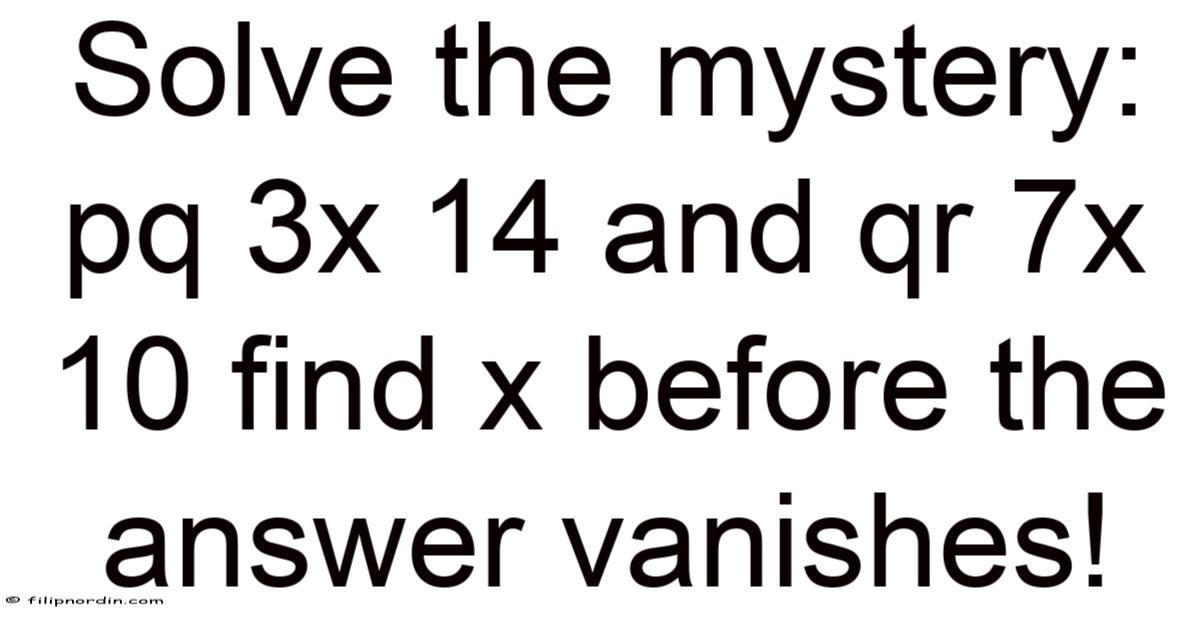
Day to day, “PQ = 3x + 14 and QR = 7x + 10, find x. Because of that, ”
It looks simple enough—just two expressions, one variable, and a “find x” at the end. But if you’re staring at it wondering where to even start, you’re in the right place. This isn’t just about plugging numbers into a formula. It’s about understanding what the problem is really asking, and how those little letters and numbers fit together to describe a real geometric situation Turns out it matters..
Let’s break it down. Which means no jargon, no rush. Just a clear, step-by-step walk through what this problem means, why it matters, and exactly how to solve it Practical, not theoretical..
What Is This Problem, Really?
First things first: what are we looking at?
Consider this: the notation “PQ” and “QR” refers to line segments—specifically, the distance from point P to point Q, and from point Q to point R. So PQ is 3 times some number x, plus 14. The expressions “3x + 14” and “7x + 10” are giving those lengths in terms of an unknown value, x. QR is 7 times that same x, plus 10.
But here’s the thing: the problem doesn’t tell us the whole picture. So naturally, are P, Q, and R in a triangle? Are they on a straight line? Day to day, most often, when you see a problem like this, it’s assuming that points P, Q, and R are collinear—meaning they lie on the same straight line—and that Q is between P and R. Think about it: in that case, the distance from P to R is just PQ plus QR. That’s the Segment Addition Postulate: if B is between A and C, then AB + BC = AC.
People argue about this. Here's where I land on it.
So the hidden piece of information is usually that PR = PQ + QR. And that’s the key to solving for x.
The Setup
Let’s write down what we know:
- PQ = 3x + 14
- QR = 7x + 10
If Q is between P and R, then:
PR = PQ + QR
But we don’t have a number for PR. But here, we’re just given the two expressions. On top of that, because often, in these problems, PR is either given as a specific number, or it’s equal to something else, or maybe the problem implies that PQ and QR are equal (if it’s a midpoint situation). So why is this helpful? So what gives?
Actually, the problem as stated—just “PQ = 3x + 14 and QR = 7x + 10, find x”—is incomplete. There’s missing information. To solve for x, we need a third piece of data: either the total length PR, or a relationship between PQ and QR (like they’re equal, or one is twice the other) Simple as that..
So why would someone write this problem? Probably because it’s part of a larger diagram or word problem where that third piece is implied. For example:
- “Points P, Q, and R are collinear. Because of that, if PQ = 3x + 14 and QR = 7x + 10, and PR = 100, find x. ”
- Or: “Q is the midpoint of PR. If PQ = 3x + 14 and QR = 7x + 10, find x.
Without that extra info, we can’t get a single number for x. But we can still talk about how to solve it once we have that missing piece.
Why X Matters
You might wonder: why go through all this trouble for a letter?
Because x represents a real measurement—a length. In geometry, every variable stands for something concrete. Solving for x tells us the actual size of those segments. That’s useful in real-world applications like construction, engineering, or design, where you need to figure out unknown distances based on partial information.
And on a test or homework, these problems test your ability to translate words and symbols into mathematical relationships. It’s not just about algebra; it’s about logical reasoning Small thing, real impact..
Why It Matters / Why People Care
Geometry isn’t just about shapes; it’s about relationships. Problems like this one train you to see how parts add up to a whole, how variables represent real quantities, and how to set up equations based on geometric rules But it adds up..
In practice, this shows up when you’re working with floor plans, laying out fencing, or even in computer graphics. If you know two sides of a path and the total distance, you can solve for the unknown. It’s a foundational skill for more complex problem-solving That's the part that actually makes a difference..
But here’s what most people get wrong: they jump straight to solving without understanding the setup. They see “find x” and start manipulating the expressions, but if they don’t know the relationship between PQ and QR, they’re stuck. Or worse, they assume something that isn’t given—like that PQ and QR are equal—and get the wrong answer.
So the real lesson isn’t the algebra; it’s the thinking.
How It Works (or How to Do It)
Let’s walk through a complete solution, assuming we have that missing piece. We’ll cover two common scenarios And it works..
Scenario 1: Q is the midpoint of PR
If Q is the midpoint, then PQ = QR. That gives us an equation we can solve directly Simple, but easy to overlook..
Set the expressions equal:
3x + 14 = 7x + 10
Now solve for x.
First, subtract 3x from both sides:
14 = 4x + 10
Then subtract 10 from both sides:
Subtract 10 from both sides:
[ 4 = 4x ]
Now divide by 4:
[ x = 1. ]
With (x = 1) we can find the actual lengths:
[ \begin{aligned} PQ &= 3(1)+14 = 17,\ QR &= 7(1)+10 = 17. \end{aligned} ]
Both segments are 17 units long, confirming that Q really is the midpoint of (PR) (so (PR = 34) units) The details matter here..
Scenario 2: The whole segment (PR) is known
Suppose instead the problem states that the three points are collinear and that the total length (PR) is 100 units. In that case the relationship is
[ PQ + QR = PR. ]
Plugging in the expressions gives
[ (3x+14) + (7x+10) = 100. ]
Combine like terms:
[ 10x + 24 = 100. ]
Subtract 24:
[ 10x = 76, ]
and divide by 10:
[ x = 7.6. ]
Now we can compute the individual pieces:
[ \begin{aligned} PQ &= 3(7.6) + 14 = 22.8 + 14 = 36.8,\[4pt] QR &= 7(7.But 6) + 10 = 53. Still, 2 + 10 = 63. 2,\[4pt] PQ + QR &= 36.8 + 63.
which checks out with the given total length.
Common Pitfalls and How to Avoid Them
| Pitfall | Why It Happens | How to Fix It |
|---|---|---|
| Assuming a relationship that isn’t given (e.Plus, g. Think about it: , treating (PQ = QR) when only the total length is known) | The wording can be terse, and students often default to the “midpoint” case because it’s familiar. | Read the problem statement carefully. Highlight any words like midpoint, bisects, total length, or sum that signal which equation to set up. That's why |
| Dropping a term while simplifying | Algebraic manipulation is easy to slip on when juggling multiple terms. | Write each step on a separate line, and double‑check by substituting the result back into the original equation. |
| Forgetting units | Geometry problems are about real distances, but it’s easy to treat everything as abstract numbers. | Keep a unit label (e.g.Even so, , “meters”) attached to each expression, and verify that the final answer makes sense in context. |
| Misreading “+” as “–” (or vice‑versa) | The plus/minus symbols look similar, especially in handwritten notes. | When you copy the problem, rewrite the expressions in your own notebook, spelling out “plus” and “minus” as you go. |
Take‑away Checklist
- Identify the relationship (midpoint, sum, difference, etc.).
- Translate that relationship into an algebraic equation using the given expressions.
- Solve the equation step‑by‑step, keeping track of signs and coefficients.
- Back‑substitute to find the actual lengths and verify they satisfy the original condition.
- Interpret the answer in the context of the problem (units, feasibility, etc.).
If you follow these five steps, you’ll never be stuck wondering whether to add or equate the expressions again.
Conclusion
The mystery of “(3x + 14) and (7x + 10)” isn’t really a mystery at all—it’s a reminder that geometry problems are built on a story. Plus, the algebraic symbols are just the language we use to describe that story. By first figuring out what the story tells us (midpoint, total length, difference, etc.), we can write the correct equation, solve for (x), and then translate that number back into a concrete measurement.
So the next time you see a pair of expressions with an unknown (x) lurking between two points, pause, read the surrounding words, set up the right relationship, and then let the algebra do the heavy lifting. The answer you obtain isn’t just a number; it’s the hidden length that makes the whole geometric picture click into place.
