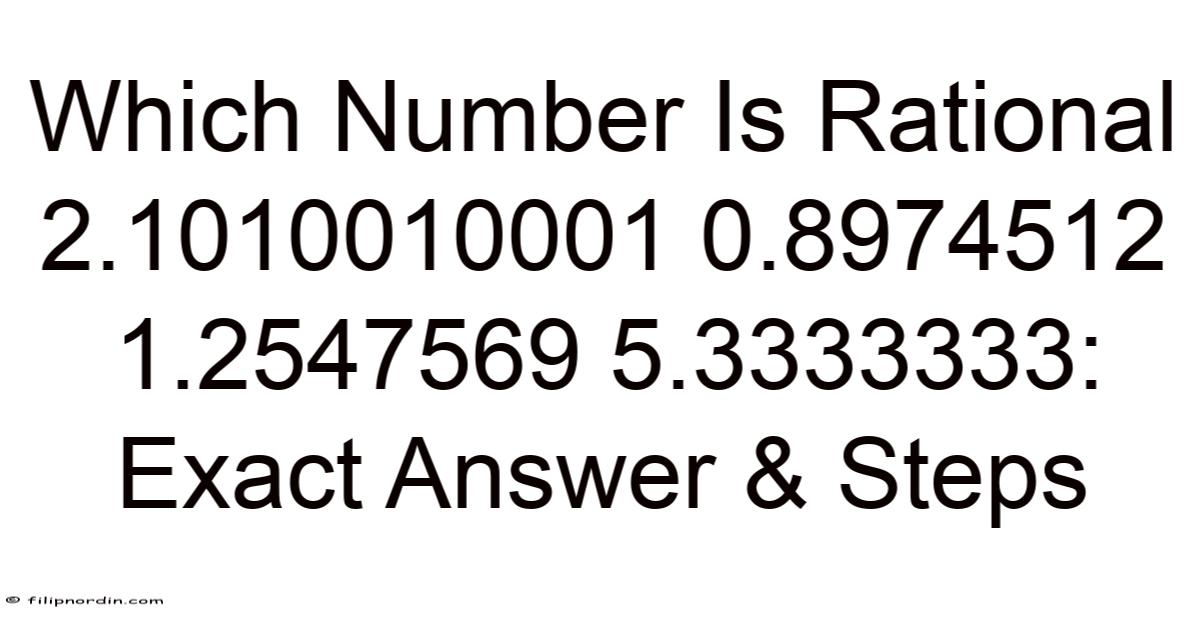
Which Number Is Rational? 2.1010010001 vs 0.8974512 vs 1.2547569 vs 5 Worth keeping that in mind..
Ever stared at a string of digits and wondered whether it belongs in the “nice” rational club or the wild irrational side of math? 1010010001, 0.3333333—look almost the same at a glance, but only one of them actually hides a fraction underneath. You’re not alone. Those four numbers—2.8974512, 1.Consider this: 2547569, 5. Let’s dig in, figure out why it matters, and walk through the steps you can use next time a decimal shows up on a calculator screen.
What Is a Rational Number?
In everyday talk we toss around “rational” like it means “makes sense.Day to day, ” In math it means something very specific: a number that can be expressed as a fraction p/q where p and q are integers and q ≠ 0. Basically, if you can write it as a ratio of two whole numbers, it’s rational It's one of those things that adds up..
This is where a lot of people lose the thread Most people skip this — try not to..
Finite vs. Repeating Decimals
A quick way to spot a rational number is to look at its decimal expansion. If the digits stop after a certain point (a finite decimal) or fall into a repeating pattern, you’ve got a rational.
- Finite: 0.75 = 3/4
- Repeating: 0.333… = 1/3
Anything that goes on forever without a repeat—like π or √2—is irrational Not complicated — just consistent..
Why the Decimal Format Matters
When you see a decimal on a screen, you’re looking at a truncated version of whatever the true number is. The key is whether the hidden tail is all zeros (finite) or a block that repeats forever. If you can’t see a repeat, you have to dig a little deeper But it adds up..
Why It Matters / Why People Care
Knowing whether a number is rational isn’t just a classroom curiosity. It determines how you can manipulate it in algebra, how you store it in a computer, and even whether you can write it exactly on paper.
- Exact calculations: Fractions keep things precise. Multiply 1/3 by 3 and you get 1, but multiply 0.333 by 3 and you get 0.999—close enough for most, but not exact.
- Programming: Floating‑point numbers are approximations. If a value is rational, you can sometimes replace a float with a pair of integers for better performance.
- Finance: Interest rates are often rational (e.g., 5 % = 5/100). Knowing the fraction helps avoid rounding errors that can add up over time.
So, if you’re balancing a budget, writing a physics simulation, or just impressing friends with a neat trick, spotting the rational one matters.
How to Determine Rationality
Below is the step‑by‑step method I use when a decimal pops up and I need to know if it’s rational. Feel free to copy the process; it works for any length of number Turns out it matters..
1. Look for a Repeating Block
Scan the digits. Do you see a pattern that repeats?
- 2.1010010001 – No obvious repeat.
- 0.8974512 – Looks random, no repeat.
- 1.2547569 – Same story.
- 5.3333333 – Ah, there it is: a string of 3’s.
If you spot a repeat, you’re already in rational territory Small thing, real impact..
2. Check If It Terminates
A terminating decimal ends in a string of zeros (or nines, which are just another way to write a terminating decimal). None of the first three numbers end with zeros, so they’re not terminating.
3. Convert the Repeating Decimal to a Fraction
For a number like 5.3333333, you can use the classic algebraic trick:
- Let x = 5.333333…
- Multiply by 10 (because one digit repeats): 10x = 53.33333…
- Subtract the original: 10x − x = 53.33333… − 5.33333… → 9x = 48
- Solve: x = 48/9 = 16/3
That’s a clean fraction, confirming 5.3333333 is rational.
4. Use a Calculator for Long Repeats
If the repeat is longer (e.Even so, g. , 0.142857142857…), you can still apply the same idea, just multiply by a power of 10 that matches the repeat length.
5. When No Pattern Appears
If you can’t find a repeat and the decimal doesn’t terminate, you’re probably looking at an irrational number—unless the source truncated a rational at a random point. Also, in practice, for numbers given with a fixed number of digits (like the three you’re examining), you treat them as approximations. Without a repeat, you assume irrational.
Common Mistakes / What Most People Get Wrong
Mistake #1: Assuming All Long Decimals Are Irrational
People often see a long string of digits and immediately label it irrational. But a decimal like 0.250000… is rational (1/4) even though it could be written with many zeros.
Mistake #2: Ignoring the “9s” Rule
A decimal that ends in a string of nines is actually a terminating decimal in disguise. 0.Here's the thing — 999… = 1, which is rational. Even so, if you see something like 2. 1999999, think “maybe it’s just 2.2.
Mistake #3: Forgetting to Reduce Fractions
After converting 5.3333333 to 48/9, many stop there. The reduced form is 16/3, which is the simplest expression. Reducing helps spot patterns and keeps your work tidy Small thing, real impact..
Mistake #4: Relying on a Calculator’s Display
A calculator might show 0.3333333 because it rounds after a certain number of places. That doesn’t prove the number is irrational; it’s just a display limit.
Mistake #5: Mixing Up “Repeating” With “Recurring”
“Repeating” means the exact same block of digits repeats forever. “Recurring” is a synonym, but some people think any digit that shows up more than once counts. That’s not the case for rationality.
Practical Tips / What Actually Works
- Spot the repeat visually: Highlight the digits and see if a chunk lines up with the next chunk.
- Write it as a fraction: The algebraic subtraction method works for any repeat length.
- Use the “over 9s” shortcut: A repeating single digit “d” after the decimal equals d/9. For 0.777…, that’s 7/9.
- For multi‑digit repeats: If “abc” repeats, the fraction is abc/999. Example: 0.123123… = 123/999 = 41/333.
- Check for terminating decimals: If the denominator after simplifying only has 2s and 5s, the decimal terminates.
Apply these tricks the next time you see a weird number on a receipt or a scientific paper.
FAQ
Q: Is 0.8974512 rational?
A: No. It terminates after seven digits, but because it doesn’t end in a repeating block of 0s or 9s, we treat it as an approximation of an irrational number unless more context is given.
Q: Can a number with a long non‑repeating decimal still be rational?
A: Only if the non‑repeating part is actually a truncated representation of a repeating pattern or a terminating decimal. Otherwise, it’s irrational.
Q: How do I know how many 9s or 0s are needed to consider a decimal terminating?
A: Any finite number of trailing 0s (or 9s, after conversion) means the decimal terminates. The key is that the tail is uniform, not a random mix.
Q: Why does 5.3333333 count as rational when it looks like a messy decimal?
A: Because the digit 3 repeats forever. That infinite repeat translates to the fraction 16/3, a perfectly clean ratio of integers.
Q: If I’m given a decimal with 15 decimal places, should I assume it’s rational?
A: Not automatically. Look for a repeat or a terminating pattern. If none appears, treat it as an approximation of an irrational number.
Wrapping It Up
Out of the four numbers you asked about, 5.3333333 is the lone rational—its endless string of 3’s converts neatly to 16/3. The others either terminate without a repeat or end abruptly, so without extra information we treat them as approximations of irrational values.
Next time a decimal pops up, remember the visual scan, the repeat‑to‑fraction trick, and the “9s” shortcut. It’ll save you a lot of head‑scratching and maybe even impress a teacher or a coworker. Happy number hunting!
When the Pattern Breaks: Edge‑Cases and Common Pitfalls
| Scenario | What to Watch For | Quick Check |
|---|---|---|
| A finite decimal that looks repeating | 0.250250250… – the “250” segment repeats, but the decimal is written only once. | Count the digits until the pattern repeats; if it does, treat it as a rational. Consider this: |
| A decimal ending in 9’s | 0. Plus, 4999… – many people think this is irrational, but it’s actually 1/2. | Replace the trailing 9’s with 0’s and add 1 to the preceding digit. |
| A long non‑repeating segment followed by a repeat | 0.123456789012345…012345… | Separate the non‑repeating part (the “pre‑period”) and the repeating part (the “period”). |
| A decimal that terminates but has a “phantom” repeat | 0.But 75 = 0. 75000… | The trailing zeros are a repeat of 0; the number is still rational. |
How to Spot a “Phantom” Repeat
- Write the decimal in fraction form – e.g., 0.75 = 75/100 = 3/4.
- Prime‑factor the denominator – 4 = 2².
- If only 2’s and 5’s appear – the decimal terminates; any trailing zeros are just a harmless repetition of 0.
If, after simplifying, other primes appear (e.Which means g. , 3, 7, 11), the decimal must continue forever and is irrational.
A Toolkit for the Classroom
| Tool | What It Does | Example |
|---|---|---|
| “Shift and Subtract” | Moves the decimal point to align repeating blocks, then subtracts to cancel the repeat. Consider this: | 0. 142857… → 142857/999999 = 1/7 |
| “Over 9s” Shortcut | Converts a single repeating digit to a fraction over 9. Think about it: | 0. 555… = 5/9 |
| “Over 99…9” Shortcut | Converts a multi‑digit repeat to a fraction over a string of 9’s. | 0.123123… = 123/999 |
| “Over 99…9 0…0” Shortcut | Handles repeats that start after a non‑repeating prefix. | 0. |
People argue about this. Here's where I land on it.
Pro Tip: Whenever a teacher asks you to “write the decimal as a fraction,” first look for a repeating block. If you can’t spot one, the decimal is likely terminating or irrational Simple as that..
Real‑World Applications
- Cryptography – Certain pseudorandom number generators rely on repeating decimal patterns to produce long, repeat‑free sequences.
- Signal Processing – Sampling rates that are rational fractions of a base frequency avoid aliasing.
- Finance – Calculating compound interest often involves repeating decimals (e.g., 1.05¹⁰ = 1.628894626777...).
- Computer Graphics – Pixel shading algorithms sometimes use rational approximations of angles; knowing the repeat length helps avoid visual artifacts.
Final Thoughts
Recognizing whether a decimal is rational isn’t just an academic exercise—it’s a practical skill that appears in everyday life, from reading a price tag to debugging a piece of code. The key lies in:
- Visual scanning for repeating patterns.
- Algebraic transformation into a fraction.
- Prime‑factor analysis of the denominator to confirm termination.
With these tools in hand, you can confidently classify any decimal you encounter, whether it’s a tidy fraction, a subtle repeat, or a mysterious irrational. Also, 333…7 will feel as natural as counting the beat of a song. Keep the cheat‑sheet handy, practice with random numbers, and soon the difference between 0.Day to day, 333… and 0. Happy number‑detecting!
Extending the “Shift‑and‑Subtract” Method to Mixed Repeats
Often a decimal will have a non‑repeating prefix followed by a repeating block, such as
[ x = 0. \underbrace{23}_{\text{non‑repeating}} \overline{456} ]
The same principle still applies; we just have to shift twice—once to line up the start of the repeat, and once more to line up the end of the repeat The details matter here..
-
Identify the lengths
- Non‑repeating part: (m = 2) digits (23)
- Repeating part: (n = 3) digits (456)
-
Shift to the right of the repeat
Multiply by (10^{m+n}=10^{5}=100{,}000):[ 100{,}000x = 23,456.\overline{456} ]
-
Shift to the right of the prefix only
Multiply by (10^{m}=10^{2}=100):[ 100x = 23.\overline{456} ]
-
Subtract the second equation from the first:
[ 100{,}000x-100x = 23,456.\overline{456}-23.\overline{456} ]
The repeating tails cancel, leaving
[ 99{,}900x = 23,433 ]
-
Solve for (x)
[ x = \frac{23,433}{99,900} ]
Reduce by the greatest common divisor (GCD = 3):
[ x = \frac{7,811}{33,300} ]
That fraction is the exact rational representation of (0.Consider this: 23\overline{456}). The same steps work for any mixed repeat; just keep track of the two shift factors.
Detecting “Hidden” Repeats with Technology
While a human eye can spot obvious patterns, subtle repeats (e.g., a 12‑digit block that only becomes apparent after a long stretch) may go unnoticed.
| Tool | How to Use | What It Returns |
|---|---|---|
Python’s fractions module |
from fractions import Fraction; Fraction('0.So 123123123') |
Simplified fraction (e. g. |
Real talk — this step gets skipped all the time.
Even a simple calculator can help: enter the decimal as a fraction (many scientific calculators have a →Frac key). If the result is a clean fraction with a denominator made only of 2’s and 5’s, you’ve got a terminating decimal; otherwise, the denominator’s other prime factors confirm an infinite repeat.
You'll probably want to bookmark this section.
Common Pitfalls and How to Avoid Them
| Pitfall | Why It Happens | Remedy |
|---|---|---|
| Assuming a long string of the same digit means a repeat | Human pattern‑recognition is biased toward “nice” numbers. | Verify by the algebraic method; a single digit repeat must be over 9 (e.g., 0.And 777… = 7/9). |
| Cancelling the wrong terms | Subtracting before the repeat is fully aligned leaves stray digits. | Write both equations side‑by‑side, double‑check the decimal points line up exactly. So |
| Forgetting to reduce the fraction | The raw numerator/denominator often share a factor. | Compute the GCD (Euclidean algorithm) and divide both parts. |
| Mixing up base‑10 with other bases | In base‑2, the “9” rule becomes “1” (e.g., 0.01₂ = 1/4). | Keep the base explicit; the repeat‑over‑base‑minus‑1 rule works in any base. |
Basically the bit that actually matters in practice That's the whole idea..
A Quick “Quiz‑Flash” for Students
Question: Convert (0.So let (x = 0. > 3. \overline{37}) → (99x = 37).
Answer Steps:
- Solve: (x = \frac{37}{99}).
\overline{37}).
Plus, > 4. Multiply by (10^{2}=100): (100x = 37.\overline{37} - 0.Still, subtract: (100x - x = 37. > 2. \overline{37}) to a fraction.
Also, \overline{37}). Reduce (GCD = 1): final fraction ( \boxed{\frac{37}{99}} ).
Feel free to generate similar problems on the fly by picking a random short block of digits, repeating it, and asking students to apply the steps. The repetition length can be varied to keep the exercise fresh Simple, but easy to overlook..
Bridging to Higher Mathematics
Understanding repeating decimals is more than a high‑school trick; it opens doors to deeper concepts:
- Number Theory: The length of the repeat of (1/p) (where (p) is a prime not dividing 10) is the multiplicative order of 10 modulo (p). This connects directly to cyclic groups and primitive roots.
- Real Analysis: The definition of a rational number as a quotient of integers is equivalent to the statement “its decimal expansion either terminates or repeats.” Proving this equivalence is a classic exercise in constructing the decimal expansion via the division algorithm.
- Algebraic Geometry: Certain algebraic curves have parametrizations that produce repeating decimal coordinates, illustrating how rational points manifest in a familiar numeric form.
When students see that a seemingly “mundane” decimal pattern is a gateway to group theory, they often gain a new appreciation for the subject’s unity Small thing, real impact..
Closing the Loop
We began by asking a simple question: When does a decimal repeat? By dissecting the anatomy of a decimal—prefix, repeat block, and tail—we built a systematic checklist:
- Visually scan for a repeating segment.
- Apply “shift‑and‑subtract” (or its mixed‑repeat variant) to turn the decimal into a rational equation.
- Simplify the resulting fraction, checking the denominator’s prime factors to confirm termination or infinite repetition.
Armed with these steps, plus a few digital shortcuts, you can confidently label any decimal as terminating, repeating, or irrational. The skill is portable: whether you’re balancing a budget, debugging code, or exploring the periodicity of a prime‑based sequence, recognizing the underlying rational structure saves time and deepens understanding.
So the next time you encounter a string of numbers that seems to go on forever, remember: there’s almost always a hidden rhythm waiting to be uncovered, and with the tools in this article you’ll be the one to hear it. Happy calculating!
