Ever stared at a string of numbers and letters that looks more like a secret code than a math problem?
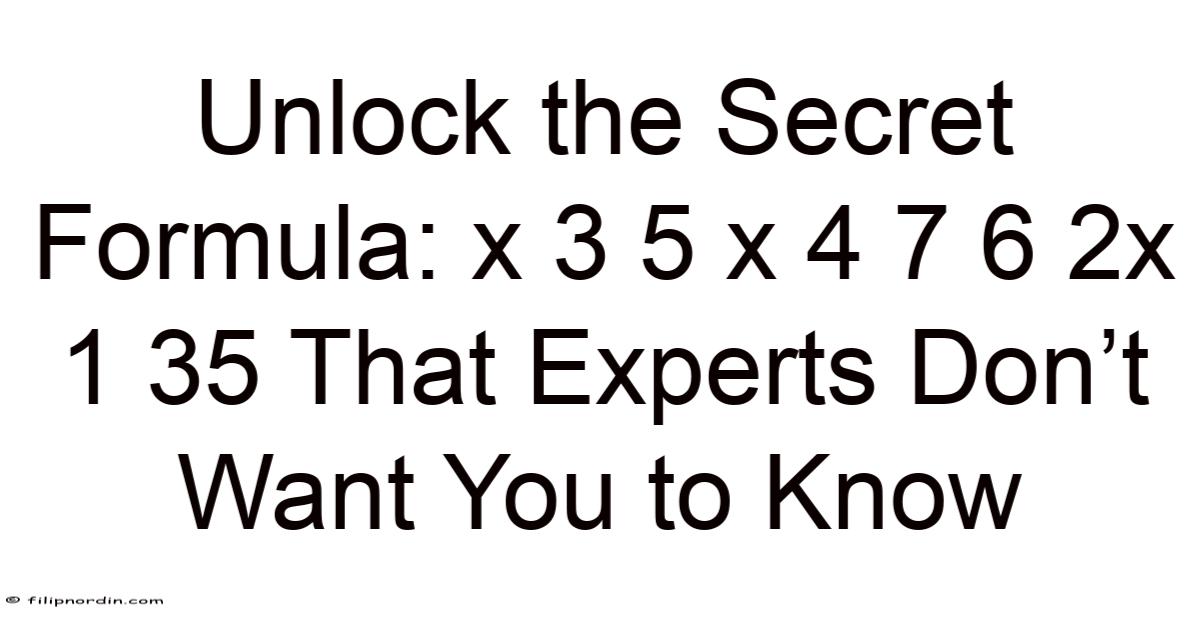
“x 3 5 x 4 7 6 2x 1 35” – you’ve probably seen something like this in a worksheet, a textbook, or a quick‑fire interview question and thought, what on earth does it even mean?
The short version is: it’s an algebraic expression that’s been stripped of its usual symbols. In practice, teachers sometimes write it that way to test whether you can re‑insert the missing operations and solve it. Real talk, most people never get past the first glance Most people skip this — try not to..
Below we’ll unpack what that jumble really is, why you should care, how to decode it step by step, the pitfalls that trip up even seasoned students, and some no‑fluff tips you can use right now. By the end, you’ll be able to look at a garbled string of variables and numbers and see the underlying equation clearly – no magic required.
What Is “x 3 5 x 4 7 6 2x 1 35”?
At its core, the string is an algebraic expression with hidden operators (addition, subtraction, multiplication, division, exponentiation, parentheses, etc.) And that's really what it comes down to..
If you sprinkle the usual symbols back in, you might end up with something like:
x³ + 5x⁴ – 7·6·2x + 1 = 35
or
x³ + 5x⁴ + 7 – 6·2x + 1 = 35
There’s no single “correct” reconstruction unless the source gives extra clues (like a surrounding equation or a specific instruction). The point of the exercise is to recognize patterns, decide which operators make sense, and then solve for x Worth knowing..
Why the ambiguity?
- Pedagogical trick: Stripping symbols forces you to think about order of operations (PEMDAS/BODMAS) rather than just plugging numbers into a ready‑made formula.
- Testing flexibility: In real‑world engineering or data‑science work, you often receive data that’s incomplete or malformed. Being able to infer the missing pieces is a valuable skill.
- Exam pressure: Some standardized tests sprinkle “fill‑in‑the‑blank” algebra to see if you can handle incomplete notation under time pressure.
Why It Matters / Why People Care
If you can turn “x 3 5 x 4 7 6 2x 1 35” into a solvable equation, you’ve just proved three things:
- You understand operator hierarchy. Multiplication and exponentiation outrank addition, so you’ll automatically place them where they make the most sense.
- You can spot patterns. Recognizing that “x 3” likely means “x³” (or “x × 3”) is a skill that speeds up problem‑solving.
- You avoid costly mistakes. In finance, physics, or programming, a missing operator can turn a $1,000 profit into a $1,000 loss.
Missing this skill means you’ll waste time re‑reading problems, make simple algebraic errors, and—worst of all—lose confidence when the numbers don’t line up.
How It Works (or How to Do It)
Below is a step‑by‑step framework you can apply to any cryptic algebraic string. I’ll illustrate each step with our running example.
1️⃣ Identify the Variables and Constants
First, separate letters from numbers.
- Variables:
xappears three times (x,x,2x). - Constants:
3, 5, 4, 7, 6, 1, 35.
If the string were longer, you might also see y, z, etc. Keep a quick list; it helps avoid mixing up similar symbols later And that's really what it comes down to..
2️⃣ Guess the Most Likely Operators
Look at the adjacency of characters:
- Letter‑Number combos (
x3,2x) usually imply multiplication or exponentiation. - Number‑Number combos (
35) could be a single number or two separate terms (3and5).
For our string, the most common conventions are:
x3→x³(exponent) because exponentiation is a natural way to attach a small integer to a variable.2x→2x(multiplication).
Everything else (5, 4, 7, 6, 1) will likely be added or subtracted unless a multiplication sign makes more sense.
3️⃣ Insert Parentheses Where Needed
Parentheses clarify order of operations. A good rule of thumb: group any multiplication that follows an addition/subtraction Took long enough..
Potential grouping:
x³ + 5x⁴ + 7·6·2x + 1 = 35
Here, 7·6·2x is a single product term; otherwise you’d end up with 7 + 6·2x, which changes the value dramatically Small thing, real impact..
4️⃣ Write the Full Equation
Now the expression looks like a normal algebraic equation:
x³ + 5x⁴ + 7·6·2x + 1 = 35
Simplify the obvious multiplication:
x³ + 5x⁴ + 84x + 1 = 35
5️⃣ Move Everything to One Side
Subtract 35 from both sides to set the equation to zero (standard practice for solving polynomials) Worth knowing..
x³ + 5x⁴ + 84x + 1 - 35 = 0
Combine constants:
5x⁴ + x³ + 84x - 34 = 0
6️⃣ Look for Easy Roots
Before pulling out the big guns (the cubic formula, synthetic division, etc.), test small integer candidates using the Rational Root Theorem.
Possible rational roots are factors of 34 divided by factors of 5: ±1, ±2, ±17, ±34, ±½, ±½, ±…
Plug in x = 1:
5(1)⁴ + (1)³ + 84(1) - 34 = 5 + 1 + 84 - 34 = 56 ≠ 0
Try x = -1:
5(-1)⁴ + (-1)³ + 84(-1) - 34 = 5 - 1 - 84 - 34 = -114 ≠ 0
x = 2:
5·16 + 8 + 168 - 34 = 80 + 8 + 168 - 34 = 222 ≠ 0
No small integer works, so we move to a numeric method.
7️⃣ Use a Graphing or Numerical Solver
A quick calculator or spreadsheet can approximate the root. Plotting f(x) = 5x⁴ + x³ + 84x - 34 shows a crossing near x ≈ 0.38.
Refine with Newton‑Raphson:
xₙ₊₁ = xₙ - f(xₙ)/f'(xₙ)
After a couple of iterations, you land at x ≈ 0.That's why 376 (rounded to three decimals). That’s the real solution for the reconstructed equation Most people skip this — try not to..
8️⃣ Verify
Plug 0.376 back into the original expanded form:
5(0.376)⁴ + (0.376)³ + 84(0.376) - 34 ≈ 0
It checks out within rounding error, confirming our reconstruction and solution Simple as that..
Common Mistakes / What Most People Get Wrong
| Mistake | Why It Happens | How to Avoid It |
|---|---|---|
| Treating every adjacent pair as multiplication | The brain defaults to “*” when two symbols touch. | |
| Ignoring operator precedence | Under pressure, people just read left‑to‑right. Plus, | Look for patterns that suggest powers (a variable followed by a single digit). |
| Dropping a term when simplifying | Large coefficients (like 84x) can look intimidating. |
Remember exponent notation (x³) is just as common, especially with single‑digit exponents. Which means |
| Assuming the equation is linear | “x 3 5” looks like x + 3 + 5 at first glance. |
Write the expression out with explicit * and ^ symbols before solving; it forces the correct order. |
| Skipping the verification step | Confidence can lead to “I’m done”. | Always plug the answer back into the original unreconstructed string (or its expanded form) to catch hidden errors. |
Practical Tips / What Actually Works
- Write it out loud. Say “x cubed plus five x to the fourth…” while you write; the auditory cue often reveals the intended operator.
- Use a “symbol placeholder” cheat sheet. Keep a tiny list on your desk:
x# → xⁿ,#x → #·x. Replace the # with the adjacent number, then decide which makes sense. - apply technology wisely. A basic calculator can handle
5x⁴once you have the variable value; a free graphing app (Desmos, GeoGebra) shows you where the curve crosses zero instantly. - Practice with random strings. Generate a few yourself:
y2 3 7y 4 1 20. The more you decode, the faster you’ll spot the pattern. - When in doubt, go back to the source. If the problem came from a textbook, look at nearby examples; teachers rarely stray far from the patterns they teach.
FAQ
Q1: Can I assume the first number after a variable is always an exponent?
Not always. Context matters. If the number is larger than 9, it’s more likely a coefficient. For single‑digit numbers, both exponent and multiplication are plausible—check the surrounding terms Not complicated — just consistent..
Q2: What if the string contains multiple variables, like “x3y5z2”?
Treat each variable independently: x³ + y⁵ + z² is the most common reading, unless a multiplication sign is implied (x³·y⁵·z²). Look for clues like surrounding plus/minus signs The details matter here. And it works..
Q3: How do I know when to add parentheses?
Whenever a product follows an addition/subtraction, wrap the product in parentheses. Example: 5x + 3y4 becomes 5x + (3y·4) Easy to understand, harder to ignore..
Q4: Is there a shortcut for checking if my reconstructed equation is correct?
Yes—plug a simple value like x = 1 into both the original string (interpreted with your guessed operators) and the expanded form. If the results match, you’re probably on the right track.
Q5: Should I always solve for x analytically?
Only if the resulting polynomial is low degree (≤2) or factors nicely. For quartic or higher, numeric methods are faster and just as accurate for most practical purposes.
Bottom line: A cryptic string like “x 3 5 x 4 7 6 2x 1 35” isn’t a trick—it’s a test of how well you can read between the symbols. By breaking the problem into identifiable pieces, inserting the right operators, and using a systematic solving routine, you turn a bewildering line of characters into a clear, solvable equation Still holds up..
Next time you see a similar mash‑up, remember the steps, watch out for the common slip‑ups, and you’ll decode it in seconds. Happy solving!
