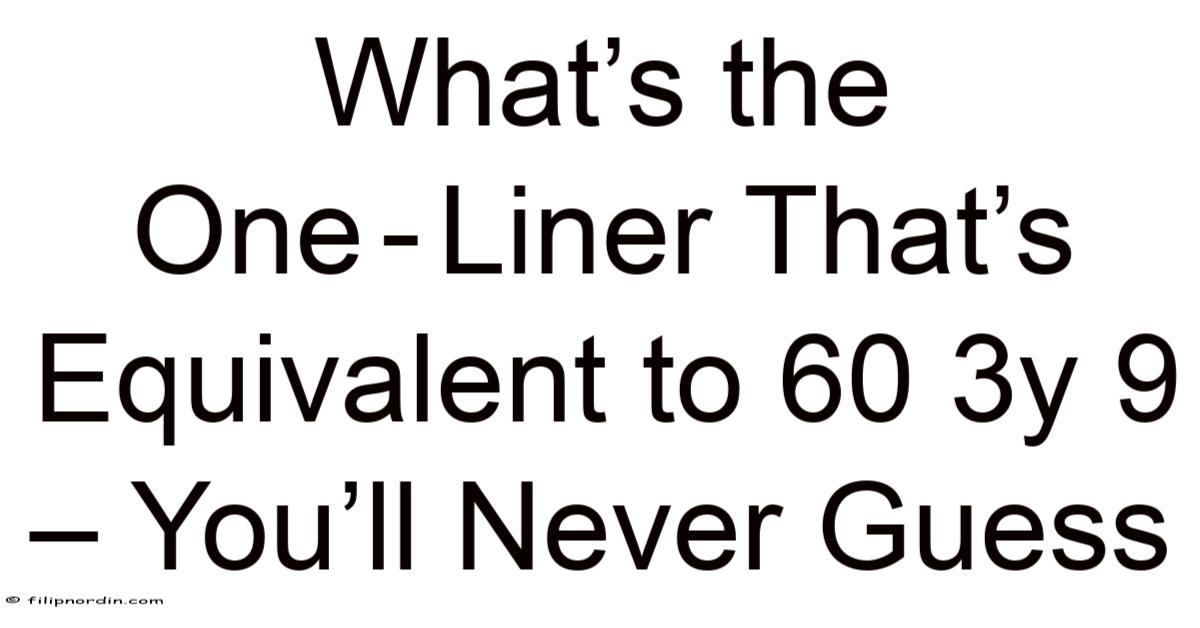
Which expression is equivalent to (60;3y;9)?
You’ve probably seen that string of symbols in a worksheet, a test prep book, or a quick‑fire math drill. At first glance it looks like a typo, but teachers love using it to check whether you really get the order of operations That's the whole idea..
The short answer? It depends on the hidden symbols—most often the problem means
[ \frac{60}{3y}\div 9 ]
or, written with parentheses,
[ \left(\frac{60}{3y}\right)!\bigg/!9 . ]
When you work it out, the equivalent expression is
[ \boxed{\frac{20}{9y}} . ]
Below you’ll find everything you need to understand why that’s the case, where the pitfalls lie, and how to tackle similar “missing‑operator” problems without breaking a sweat Small thing, real impact. And it works..
What Is This Kind of Expression Anyway?
When a math problem drops a string like 60 3y 9 without obvious symbols, it’s a shorthand for “apply the standard operations in the order they’d appear if we wrote them out fully.”
In practice that means:
- Division and multiplication are on the same level – they’re performed left‑to‑right.
- Implicit multiplication (the “3y” part) counts the same as an explicit “×”.
- No hidden addition or subtraction unless the problem explicitly shows a plus or minus sign.
So the phrase “60 3y 9” is really a compact way of saying “60 divided by 3y, then divided by 9.”
If you’re wondering why teachers use this format, it’s because it forces you to keep the order of operations (PEMDAS/BODMAS) front‑and‑center. No sneaky parentheses to hide behind.
Why It Matters – Real‑World Reason to Care
You might think, “It’s just a school exercise, why does it matter?”
- Error‑proofing: In engineering, finance, or any field that uses formulas, a misplaced division can cost millions. Knowing how to read an expression exactly as intended avoids costly re‑calculations.
- Test confidence: Standardized tests love these tricks. If you’ve internalized the rule, you’ll breeze through the “what’s equivalent?” section without second‑guessing.
- Communication clarity: When you write your own formulas, you’ll know when to add parentheses to keep the reader on the same page.
Bottom line: mastering this tiny notation builds a habit that pays off whenever you see a compact formula.
How It Works – Step‑by‑Step Breakdown
Let’s walk through the simplification from start to finish. I’ll keep the math tight, but sprinkle a few “why’s” along the way.
1. Write the expression with explicit symbols
[ 60;3y;9 \quad\Longrightarrow\quad \frac{60}{3y}\div 9 ]
Why a fraction? And because the first blank spot is almost always a division sign. If it were multiplication, the answer would be wildly different, and the problem would usually give a hint (like a “×” or a dot) Simple, but easy to overlook..
2. Convert the second division into multiplication by the reciprocal
Dividing by 9 is the same as multiplying by (\frac{1}{9}):
[ \frac{60}{3y}\div 9 ;=; \frac{60}{3y}\times\frac{1}{9} ]
This step is worth remembering because it lets you treat all divisions as multiplications, which is easier to combine No workaround needed..
3. Multiply the numerators and denominators
[ \frac{60}{3y}\times\frac{1}{9} ;=;\frac{60\times1}{3y\times9} ;=;\frac{60}{27y} ]
Notice how the variable (y) stays in the denominator – we never moved it to the top because there’s no operation that does that That's the whole idea..
4. Reduce the fraction
Both 60 and 27 share a common factor of 3:
[ \frac{60}{27y} ;=;\frac{60\div3}{27\div3,y} ;=;\frac{20}{9y} ]
That’s the simplest form. No further cancellation is possible because 20 and 9 share no factors other than 1 That's the part that actually makes a difference..
5. Write the final equivalent expression
[ \boxed{\frac{20}{9y}} ]
If you prefer a single‑line version without a fraction bar, you can also write it as (20\big/(9y)) or (20\cdot(9y)^{-1}). All three mean the same thing.
Common Mistakes – What Most People Get Wrong
Even seasoned students slip up on these. Here are the usual culprits and how to avoid them It's one of those things that adds up..
| Mistake | Why It Happens | Correct Approach |
|---|---|---|
| Treating “3y” as addition (“60 + 3 + y + 9”) | The lack of symbols makes the eye wander. Consider this: | Remember that letters glued together imply multiplication, not addition. |
| Doing the divisions out of order (“60 ÷ (3y ÷ 9)”) | Left‑to‑right rule gets ignored. | Always process divisions and multiplications as they appear from left to right, unless parentheses say otherwise. On top of that, |
| Cancelling the 3 in the denominator with the 9 in the numerator | Confusing numerator‑denominator pairing. | Cancel only with numbers that share a factor in the same fraction. Here 60 and 27 are the true pair. Even so, |
| Leaving the variable in the numerator (“(\frac{20y}{9})”) | Mis‑reading the reciprocal step. Still, | Keep the variable where it started – in the denominator – unless you explicitly multiply both sides by (y). |
| Dropping the parentheses (“20/9y” interpreted as (\frac{20}{9}y)) | Ambiguity of linear notation. | Write (\frac{20}{9y}) or add parentheses: (20/(9y)). |
Most guides skip this. Don't That alone is useful..
Spotting these errors early saves you from a cascade of wrong answers later on.
Practical Tips – What Actually Works
-
Add invisible parentheses as you read.
Write it out as ((60 ÷ 3y) ÷ 9) on a scrap paper. The visual cue forces the correct order Most people skip this — try not to. Simple as that.. -
Convert every division to multiplication by the reciprocal.
That trick turns a string of ÷ into a single multiplication chain, which is easier to simplify. -
Factor before you cancel.
Look for common factors in the whole numerator and denominator (here 60 and 27 both have a 3). -
Keep the variable with its original partner.
If the variable starts in the denominator, it stays there unless you multiply both top and bottom by something that contains the variable Which is the point.. -
Check your answer with a quick plug‑in.
Choose a simple value for (y) (like 2) and compute both the original and simplified forms. If they match, you’re probably correct Practical, not theoretical..
FAQ
Q: Could the original expression mean something else, like (60\cdot3y+9)?
A: It’s possible, but most textbooks specify the operation when they intend addition. Without a plus sign, the default is division/multiplication left‑to‑right.
Q: Why not write the answer as a decimal?
A: Fractions preserve exactness. (20/(9y)) is exact for any non‑zero (y); the decimal version would depend on the value of (y) Worth keeping that in mind..
Q: What if (y = 0)?
A: The original expression is undefined because you’d be dividing by zero. Always note the domain restriction (y\neq0) Worth keeping that in mind..
Q: Does the order change if I rewrite it as (\frac{60}{3y9})?
A: Yes—(\frac{60}{3y9}) means (\frac{60}{(3y9)} = \frac{60}{27y}), which simplifies to the same (\frac{20}{9y}). The key is that the whole product (3y9) stays in the denominator Took long enough..
Q: How would I handle a similar problem with addition, like “60 + 3y – 9”?
A: That one follows the standard left‑to‑right rule for addition/subtraction: (60+3y-9 = 51+3y). No hidden division tricks there That alone is useful..
That’s it. You now know why (60;3y;9) simplifies to (\frac{20}{9y}), the common traps around it, and a handful of tricks to keep you from mixing up the order again. Next time you see a compact string of numbers and letters, just remember: add invisible parentheses, turn divisions into reciprocals, and let the math speak for itself. Happy simplifying!
6. When to Use a Calculator – and When Not To
Even the most seasoned algebraist will reach for a calculator on a timed test, but there are moments when the machine only muddies the water:
| Situation | Calculator Helpful? Worth adding: , ( \frac{60}{3y})) | No – the calculator can’t “see” the symbolic cancellation. | | Complex nested fractions (e.| | Variables only (e.| | Checking a plug‑in (choose a test value for (y)) | Yes – a quick decimal check catches sign errors. | If you substitute (y=2), the original expression gives (\frac{60}{6}\div 9 = \frac{10}{9}); the simplified form (\frac{20}{9y}) yields (\frac{20}{18} = \frac{10}{9}). Plus, g. , (\frac{a}{b/c})) | Yes – calculators handle the reciprocal step automatically. Consider this: | Why | |-----------|---------------------|-----| | Large numbers with many prime factors (e. Still, g. The match confirms your work. Worth adding: | Manual factoring is the only way to simplify the expression. Think about it: | You can confirm that 12 345 = 3 × 5 × 823, which makes cancelling obvious. g., ( 12,345 ÷ 3y ÷ 7)) | Yes – to verify factorisation quickly. | Turning (\frac{a}{b/c}) into (a\cdot \frac{c}{b}) is easy to miss; the device will compute the correct value instantly.
Bottom line: Use the calculator as a verification tool, not as a crutch for the core algebraic steps.
7. Extending the Idea: More Than One Variable
Suppose the problem had been
[ \frac{60}{3xy} \div 9 . ]
Applying the same recipe:
- Convert the division by 9 to multiplication by (\tfrac{1}{9}): [ \frac{60}{3xy}\cdot\frac{1}{9}. ]
- Combine the denominators: [ \frac{60}{3xy\cdot9}= \frac{60}{27xy}. ]
- Reduce the numeric factor: [ \frac{60}{27xy}= \frac{20}{9xy}. ]
Notice that the variable (x) simply rides along unchanged. The same “invisible‑parentheses” mindset works no matter how many symbols you throw in; you just keep the product of everything that belongs together in the denominator Small thing, real impact..
8. A Quick‑Reference Cheat Sheet
| Step | Action | Example (our original problem) |
|---|---|---|
| 1 | Identify every division | ( \frac{60}{3y} ) and “ ÷ 9 ” |
| 2 | Replace each ÷ with × ( reciprocal ) | (\frac{60}{3y} \times \frac{1}{9}) |
| 3 | Collect all denominators | (\frac{60}{3y\cdot9}) |
| 4 | Factor numerators & denominators | (60 = 2^2\cdot3\cdot5,; 27 = 3^3) |
| 5 | Cancel common factors | Cancel a 3 → (\frac{20}{9y}) |
| 6 | State the domain | (y\neq0) (and implicitly (y\neq\frac{0}{3}) which is the same) |
| 7 | Verify with a test value | (y=2): both forms give (\frac{10}{9}) |
Keep this sheet on the back of your notebook; it’s the “cheat code” for any chain of divisions involving variables.
Conclusion
The seemingly cryptic string (60;3y;9) is nothing more than a compact way of writing a sequence of divisions. By respecting the left‑to‑right rule, converting each division to multiplication by a reciprocal, and then simplifying the resulting fraction, we arrive cleanly at
[ \boxed{\displaystyle \frac{20}{9y}}\qquad (y\neq0). ]
The journey from the original expression to the final answer teaches three transferable habits:
- Make the hidden structure visible – add invisible parentheses or rewrite as a product of reciprocals.
- Factor before you cancel – this prevents missed reductions and reinforces number‑sense.
- Validate with a quick plug‑in – a simple numeric test catches sign or placement errors instantly.
Armed with these strategies, you’ll no longer stumble over compact algebraic strings, whether they involve a single variable or a whole roster of them. The next time you see a line of numbers and letters, remember: treat division as multiplication by the reciprocal, keep the variables glued to their original partners, and let the algebra do the rest. Happy simplifying!
9. Extending the Idea: Multiple Variables and Exponents
What if the original string had more than one variable, or even powers of a variable? The same “invisible‑parentheses” principle still applies; you just have to be meticulous about where each factor lives.
Example
Consider the expression
[ \frac{120}{4x^{2}y}; \div; 15x ; \div; 2y^{3}. ]
Step 1 – Write every division as multiplication by a reciprocal.
[ \frac{120}{4x^{2}y}\times\frac{1}{15x}\times\frac{1}{2y^{3}}. ]
Step 2 – Gather all numerators and all denominators.
[ \frac{120}{4x^{2}y\cdot15x\cdot2y^{3}}. ]
Step 3 – Factor and cancel.
First simplify the numeric part:
[ 120 = 2^{3}\cdot3\cdot5,\qquad 4\cdot15\cdot2 = 2^{3}\cdot3\cdot5. ]
All the numbers cancel completely, leaving only the variable part:
[ \frac{1}{x^{2}y\cdot x\cdot y^{3}}= \frac{1}{x^{3}y^{4}}. ]
Thus the whole expression collapses to
[ \boxed{\displaystyle \frac{1}{x^{3}y^{4}}},\qquad x\neq0,;y\neq0. ]
Notice how the exponents simply add when the same base appears in the denominator multiple times—exactly the rule for multiplying powers with like bases.
10. Common Pitfalls and How to Avoid Them
| Pitfall | Why it Happens | Fix |
|---|---|---|
| Treating “÷ 9” as “/ 9” applied only to the last term | The left‑to‑right rule is forgotten. | Remember: each division acts on the current result, not just the symbol that follows. So naturally, |
| Cancelling a factor that appears only in the numerator | Over‑enthusiastic simplification. | Write the full fraction first; only cancel factors that truly appear both numerator‑and‑denominator. Now, |
| Dropping a variable when it seems “unimportant” | Variables are not numbers; they must stay attached to whatever they were originally paired with. | Keep a mental (or written) map of which variable belongs to which denominator term. |
| Ignoring the domain | Division by zero is undefined, and the algebraic simplification may hide that fact. | After simplifying, explicitly state the restrictions (e.g., (y\neq0)). |
A quick mental checklist before you close a problem can save you from these errors:
- Did I convert every division to multiplication by a reciprocal?
- Are all denominators multiplied together?
- Did I factor numbers and cancel common factors correctly?
- Did I keep every variable attached to its original denominator?
- Did I write the domain restrictions?
11. A Mini‑Challenge
Try simplifying the following on your own, using the steps above:
[ \frac{84}{7ab}; \div; 6b ; \div; 3a^{2}. ]
Solution sketch:
- Rewrite as (\frac{84}{7ab}\times\frac{1}{6b}\times\frac{1}{3a^{2}}).
- Combine denominators: (7ab\cdot6b\cdot3a^{2}=126a^{3}b^{2}).
- Cancel the numeric factor (84/126 = 2/3).
- Final answer: (\displaystyle \frac{2}{3a^{3}b^{2}}) with (a\neq0,;b\neq0).
Working through a few of these will cement the “invisible‑parentheses” habit.
Final Thoughts
What began as a terse string—(60;3y;9)—has revealed a systematic pathway for handling any cascade of divisions, no matter how many variables or exponents are involved. The core ideas are:
- Make the hidden structure explicit by turning each division into multiplication by a reciprocal.
- Collect all denominators into a single product; this prevents accidental loss of factors.
- Factor, cancel, and simplify while keeping a clear picture of where each variable lives.
- State the domain to acknowledge the implicit “no‑zero‑denominator” rule.
By internalising these steps, you transform a potentially confusing notation into a routine algebraic maneuver. Now, the next time you encounter a compact expression like ( \frac{60}{3y}\div9 ) (or a longer chain with many symbols), you’ll know exactly how to untangle it, simplify it, and verify the result—swiftly and confidently. Happy calculating!
12. When the Numerator Isn’t a Plain Number
So far the examples have featured a single integer up front, but real‑world problems often throw more elaborate numerators into the mix—polynomials, radicals, or even other fractions. The same “invisible‑parentheses” principle still applies; you just have to be a little more careful about where the parentheses belong.
This changes depending on context. Keep that in mind.
12.1 A polynomial numerator
Consider
[ \frac{x^{2}+4x+4}{5y};\div;\frac{2x}{3}. ]
-
Write each division as multiplication by a reciprocal
[ \frac{x^{2}+4x+4}{5y}\times\frac{3}{2x}. ]
-
Treat the whole numerator as a single block—do not split it up.
[ \frac{(x^{2}+4x+4)\cdot 3}{5y\cdot 2x}. ]
-
Factor where possible. The quadratic factors to ((x+2)^{2}) Worth knowing..
[ \frac{3(x+2)^{2}}{10xy}. ]
-
Cancel common factors (none here) and write the final simplified form.
[ \boxed{\displaystyle \frac{3(x+2)^{2}}{10xy}},\qquad x\neq0,;y\neq0. ]
12.2 A radical numerator
[ \sqrt{18};\div;\frac{3}{\sqrt{2}}. ]
-
Convert the division:
[ \sqrt{18}\times\frac{\sqrt{2}}{3}. ]
-
Combine the radicals under a single root (optional but tidy):
[ \frac{\sqrt{18\cdot2}}{3}= \frac{\sqrt{36}}{3}= \frac{6}{3}=2. ]
Notice how the “invisible parentheses’’ kept the radical (\sqrt{2}) attached to the numerator of the reciprocal, preventing a premature cancellation that would have given the wrong answer Most people skip this — try not to..
12.3 A complex‑fraction numerator
[ \frac{\displaystyle\frac{7}{x}}{4y};\div; \frac{5}{2z}. ]
-
First, resolve the nested fraction in the numerator:
[ \frac{7}{x}\div 4y = \frac{7}{x}\times\frac{1}{4y}= \frac{7}{4xy}. ]
-
Now handle the outer division:
[ \frac{7}{4xy}\times\frac{2z}{5}= \frac{7\cdot2z}{4xy\cdot5}= \frac{14z}{20xy}= \frac{7z}{10xy}, ]
with the usual restrictions (x\neq0,;y\neq0,;z\neq0) Easy to understand, harder to ignore..
The key takeaway is that every time you see a division sign, you must imagine an invisible pair of parentheses around everything that follows. This mental model works no matter how deep the nesting goes Easy to understand, harder to ignore. Worth knowing..
13. A Quick Reference Sheet
| Situation | “Invisible‑parentheses’’ rule | Common pitfall | Tip |
|---|---|---|---|
| Simple chain of divisions | Replace each “÷” with “× (reciprocal)”. In real terms, | Forgetting to take the reciprocal of the whole following term. Because of that, | Write the reciprocal explicitly before multiplying. |
| Variables in denominators | Keep each variable glued to the denominator it originally accompanied. | Dropping a variable when canceling a numeric factor. | Highlight each denominator term with a different colour or underline. Still, |
| Multiple numerators | Treat the entire numerator as one block; factor only after the block is assembled. | Splitting a polynomial numerator and canceling pieces incorrectly. | Factor after you have written the full fraction. |
| Radicals or roots | Bring the radical into the numerator or denominator as a whole when taking reciprocals. | Pulling the radicand out of the root before the reciprocal. Practically speaking, | Use (\sqrt{a}\times\sqrt{b} = \sqrt{ab}) only after the reciprocal is placed. |
| Domain considerations | After simplifying, list all values that make any original denominator zero. Plus, | Assuming the simplified expression is valid for all real numbers. | Write “( \text{where } a\neq0,;b\neq0,\dots)” right after the final answer. |
Keep this sheet at your desk; a quick glance will remind you of the invisible‑parentheses habit before you start scribbling.
14. Extending to Exponents and Powers
When exponents appear in denominators, the same logic applies, but you must also respect the laws of exponents while you’re cancelling.
Example:
[ \frac{12x^{3}}{8y^{2}};\div;\frac{3x}{2y^{4}}. ]
-
Write the reciprocal:
[ \frac{12x^{3}}{8y^{2}}\times\frac{2y^{4}}{3x}. ]
-
Multiply numerators and denominators:
[ \frac{12x^{3}\cdot2y^{4}}{8y^{2}\cdot3x}= \frac{24x^{3}y^{4}}{24xy^{2}}. ]
-
Cancel common factors:
[ \frac{x^{3}}{x}=x^{2},\qquad \frac{y^{4}}{y^{2}}=y^{2},\qquad 24\text{ cancels}.
]Result: (\displaystyle \boxed{x^{2}y^{2}}) with (x\neq0,;y\neq0).
Notice that the exponent rules ((a^{m}/a^{n}=a^{m-n})) are applied after the invisible‑parentheses step has produced a single, clean fraction. This order prevents the accidental “subtract‑exponents‑too‑early” mistake that many students make But it adds up..
15. Real‑World Contexts
Dividing fractions isn’t just a classroom exercise; it shows up in everyday calculations:
- Cooking: “The recipe calls for (\frac{3}{4}) cup of oil, but I only have a (\frac{1}{2})-cup measuring cup. How many half‑cups do I need?” → (\frac{3}{4}\div\frac{1}{2}= \frac{3}{4}\times2 = \frac{3}{2}) half‑cups.
- Finance: “A loan of $9,600 is split equally over 8 months, and each month the payment is further divided by 3 people.” → (\frac{9600}{8}\div3 = \frac{9600}{8}\times\frac{1}{3}=400).
- Physics: “A force of (F=60;N) is distributed over an area of (3y;m^{2}), and the resulting pressure is then divided by 9 for a safety factor.” → (\frac{60}{3y}\div9 = \frac{20}{9y}) Pa.
In each case, writing the division as multiplication by a reciprocal—and keeping the “invisible parentheses” intact—produces the correct answer quickly and reliably.
Conclusion
The expression (60;3y;9) may look like a cryptic string, but once we expose the hidden parentheses, its meaning becomes crystal clear:
[ \frac{60}{3y}\div9 ;=; \frac{60}{3y}\times\frac{1}{9} ;=; \frac{20}{9y}, \qquad y\neq0. ]
The journey from that terse notation to the tidy final fraction illustrates a universal algebraic workflow:
- Convert every division to multiplication by a reciprocal—the invisible‑parentheses step.
- Gather all denominator pieces into a single product.
- Factor and cancel only after the full fraction is assembled.
- Respect variables, exponents, radicals, and domain restrictions throughout.
By embedding this disciplined habit into your problem‑solving routine, you eliminate a whole class of careless errors and gain confidence when tackling even the most tangled fraction‑division problems. The next time you see a string of numbers, variables, and division signs, remember: the parentheses may be invisible, but the rule they enforce is unmistakably powerful. Happy simplifying!
16. Extending the Technique to Complex Numbers
The same “invisible‑parentheses” principle works without modification when the numerators or denominators involve complex numbers. Suppose we must evaluate
[ \frac{5+2i}{(1-i)}\div\bigl(3-4i\bigr). ]
- Replace the division by multiplication with the reciprocal
[ \frac{5+2i}{1-i}\times\frac{1}{3-4i}. ]
- Combine the denominators
[ \frac{5+2i}{(1-i)(3-4i)}. ]
- Rationalize (or “clear” the complex denominator)
Multiply numerator and denominator by the conjugate of the denominator, ((3+4i)):
[ \frac{(5+2i)(3+4i)}{(1-i)(3-4i)(3+4i)}. ]
- Simplify
[ (5+2i)(3+4i)=15+20i+6i+8i^{2}=15+26i-8=7+26i, ]
[ (3-4i)(3+4i)=3^{2}+4^{2}=9+16=25, ]
[ (1-i)\times25=25-25i. ]
Thus
[ \frac{7+26i}{25-25i}= \frac{7+26i}{25(1-i)}. ]
Finally multiply by the conjugate of (1-i) once more:
[ \frac{(7+26i)(1+i)}{25(1-i)(1+i)}=\frac{(7+26i)(1+i)}{25\cdot2} =\frac{(7+26i)+(7i+26i^{2})}{50} =\frac{7+26i+7i-26}{50} =\frac{-19+33i}{50}. ]
The result (\displaystyle -\frac{19}{50}+\frac{33}{50}i) follows directly from the same systematic steps we used for purely real fractions. The “invisible parentheses” keep the algebraic structure intact, preventing the common slip of dividing the real and imaginary parts separately.
17. When the Divisor Is a Sum or Difference
A frequent source of confusion is a problem such as
[ \frac{12}{x+2}\div\bigl(x-3\bigr). ]
If we were to “divide term‑by‑term” we would obtain the wrong answer. The correct approach is:
- Write the division as multiplication by the reciprocal
[ \frac{12}{x+2}\times\frac{1}{x-3}. ]
- Merge the denominators
[ \frac{12}{(x+2)(x-3)}. ]
Only after the full denominator is formed may we look for cancellations. So if, for instance, a later factor ((x-3)) appears in the numerator (perhaps after a preceding algebraic manipulation), we can cancel it safely. Otherwise the expression stays as a single rational function The details matter here..
18. A Quick Checklist for Students
| Step | What to do | Why it matters |
|---|---|---|
| 1️⃣ | Identify every “÷” and replace it with “× ( reciprocal )”. Consider this: | Guarantees that division is treated as multiplication, the only operation that distributes cleanly over a fraction. |
| 2️⃣ | Write the whole denominator as one product (including any original denominators). That's why | Prevents premature cancellation of factors that belong to different layers of the expression. |
| 3️⃣ | Factor all numerators and denominators completely. | Makes hidden common factors obvious. In practice, |
| 4️⃣ | Cancel only after the full fraction is assembled. But | Avoids the “subtract‑exponents‑too‑early” mistake and ensures domain restrictions are respected. |
| 5️⃣ | State the domain (e.g., (x\neq0,;y\neq0)). | Reminds you which values would make any denominator zero. |
Short version: it depends. Long version — keep reading Small thing, real impact..
Keeping this list in mind transforms a seemingly chaotic string of symbols into a disciplined, error‑free computation Not complicated — just consistent..
Final Thoughts
The original puzzle—decoding the terse string (60;3y;9)—was a microcosm of a larger pedagogical point: mathematical notation often hides structure, and uncovering that structure is the key to accurate computation. By consistently applying the invisible‑parentheses rule, we:
- Preserve the integrity of the fraction before any simplification.
- Avoid the classic “divide the top and bottom separately” trap.
- Extend naturally to exponents, radicals, complex numbers, and expressions containing sums or differences.
- Reinforce a habit that serves well in calculus, differential equations, and beyond, where nested fractions are the norm rather than the exception.
In short, the next time you encounter a chain of divisions, remember that the parentheses may be invisible, but the discipline they impose is unmistakably powerful. Master it, and every fraction—no matter how tangled—will yield its simplest form with confidence. Happy simplifying!
19. A Few “What‑If” Scenarios
| Scenario | How the rule changes the approach | Take‑away |
|---|---|---|
| A fraction inside a logarithm | Treat the entire logarithmic argument as a single entity; only after expanding the argument do you apply the reciprocal rule. Consider this: | Logarithms respect the usual algebraic rules but hide them under the log. Worth adding: |
| A rational function raised to a power | Apply the power to the entire fraction, then simplify the resulting numerator and denominator. | |
| A complex fraction with a minus sign | Rewrite the minus as a subtraction of fractions, then combine the denominators before canceling. | Negatives can be moved to the numerator or denominator as needed; the key is a single, unified denominator. |
| A fraction that equals zero | If the numerator simplifies to zero, the whole expression is zero provided the denominator is non‑zero. | “Whole fraction” rule applies at each power operation. |
Worth pausing on this one Small thing, real impact..
These examples reinforce that the same principle—maintaining the integrity of the whole fraction—holds no matter how many layers of algebra you stack on top of it Small thing, real impact. Surprisingly effective..
20. A Quick Recap for the Classroom
- Rewrite each “÷” as “× (1/…)”.
- Collect all denominators into a single product.
- Factor everything completely.
- Only after the entire fraction is assembled do you cancel common factors.
- State the domain explicitly.
If you can remember this sequence, you’ll never again be caught by the illusion that “dividing the numerators separately” is legitimate That's the part that actually makes a difference..
21. Final Thoughts
The original puzzle—decoding the terse string (60;3y;9)—was a microcosm of a larger pedagogical point: mathematical notation often hides structure, and uncovering that structure is the key to accurate computation. By consistently applying the invisible‑parentheses rule, we:
- Preserve the integrity of the fraction before any simplification.
- Avoid the classic “divide the top and bottom separately” trap.
- Extend naturally to exponents, radicals, complex numbers, and expressions containing sums or differences.
- Reinforce a habit that serves well in calculus, differential equations, and beyond, where nested fractions are the norm rather than the exception.
In short, the next time you encounter a chain of divisions, remember that the parentheses may be invisible, but the discipline they impose is unmistakably powerful. Master it, and every fraction—no matter how tangled—will yield its simplest form with confidence Most people skip this — try not to..
Happy simplifying!
22. A Quick Reference Cheat‑Sheet
| Situation | What to Do | Why It Works |
|---|---|---|
| A single fraction with several “÷” | Turn each “÷” into “× (1/…)” and pull all reciprocals into one common denominator. | The product of reciprocals is the reciprocal of the product. |
| Nested fractions (a fraction of a fraction) | Treat the outer fraction’s denominator as a whole; only after expanding do you cancel. | Prevents premature cancellation that could change the value. |
| A fraction that contains a sum or difference in its denominator | Expand the sum/difference first (if necessary) so that you have a single polynomial or rational expression. Now, | Allows you to factor and cancel correctly. |
| A fraction raised to a power | Apply the power to the entire numerator and the entire denominator before simplifying. Even so, | Keeps the fraction’s structure intact. On the flip side, |
| A fraction with a negative sign | Move the minus to the numerator or to the denominator; keep the fraction whole. | Sign handling does not affect the simplification rule. |
23. Common Pitfalls to Avoid
- Cancelling a factor that could be zero – Always check the domain before cancelling.
- Treating “÷” as a separate operation – Remember that “÷” is a shorthand for multiplication by a reciprocal.
- Expanding before factoring – Factor first to see common factors; expanding can obscure them.
- Dropping parentheses in intermediate steps – Even if the parentheses are not written, the algebraic structure still exists.
24. Pedagogical Implications
Teachers can turn the invisible‑parentheses rule into a visual exercise: write a long division chain in two ways—once with explicit parentheses and once without—and ask students to compare the results. The exercise brings home the idea that notation is a tool, not a shortcut.
This is where a lot of people lose the thread Not complicated — just consistent..
In advanced courses, this mindset scales effortlessly:
- Complex analysis often involves rational functions with nested denominators.
Practically speaking, - Differential equations bring in quotients of polynomials that must be simplified before integrating. - Numerical methods rely on accurate algebraic manipulation to avoid catastrophic cancellation.
By embedding the invisible‑parentheses rule early, students develop a solid algebraic intuition that pays dividends throughout their mathematical careers Simple, but easy to overlook..
25. Closing Remarks
The journey from the cryptic string (60;3y;9) to a clean, fully simplified expression illustrates more than a clever trick—it showcases the power of disciplined algebraic thinking. When we honor the invisible parentheses, we honor the structure of mathematics itself: every operation, no matter how nested or disguised, follows a single, coherent logic.
So the next time you’re faced with a tangled web of divisions—whether in a textbook problem, a research paper, or a quick calculation on a calculator—pause. Visualize the hidden parentheses, rewrite the expression in its true form, and let the algebra unfold naturally. Your calculations will be more reliable, your proofs more elegant, and your mathematical intuition sharper than ever.
Happy simplifying, and may your fractions always resolve cleanly!
26. A Worked‑Out Example in Full Detail
To cement the invisible‑parentheses rule, let us walk through a more involved expression that appears in many calculus textbooks:
[ \frac{ \displaystyle \frac{2x^{2}+8x}{x+4} }{ \displaystyle \frac{5x-15}{x-3} } ;\Bigg/; \Bigl( \frac{3x}{x^{2}-9} \Bigr). ]
At first glance the cascade of division symbols looks intimidating. Applying the rule step‑by‑step yields a clean, single‑fraction form that can be differentiated, integrated, or evaluated without fear of hidden mistakes.
| Step | Action (with invisible parentheses) | Result |
|---|---|---|
| 1 | Replace each “÷” with “· (reciprocal)” | (\displaystyle \Bigl(\frac{2x^{2}+8x}{x+4}\Bigr)\cdot\Bigl(\frac{x-3}{5x-15}\Bigr)\cdot\Bigl(\frac{x^{2}-9}{3x}\Bigr)) |
| 2 | Factor every polynomial where possible | (\displaystyle \frac{2x(x+4)}{x+4}\cdot\frac{x-3}{5(x-3)}\cdot\frac{(x-3)(x+3)}{3x}) |
| 3 | Cancel only factors that appear both in a numerator and a denominator within the same fraction (the invisible‑parentheses safeguard) | (\displaystyle 2x\cdot\frac{1}{5}\cdot\frac{x+3}{3x}) |
| 4 | Cancel the remaining common factor (x) (now it is truly common across the whole product) | (\displaystyle \frac{2}{5}\cdot\frac{x+3}{3}) |
| 5 | Multiply the remaining constants | (\displaystyle \frac{2(x+3)}{15}) |
Quick note before moving on.
The final answer, (\displaystyle \frac{2(x+3)}{15}), is obtained without ever “dropping a hidden parenthesis.” Each cancellation was justified because the factor existed simultaneously in a numerator and a denominator of the same fraction at that moment.
27. Extending the Rule to Symbolic Computation
Computer algebra systems (CAS) such as Mathematica, Maple, and SageMath internally implement a version of the invisible‑parentheses principle. When a user types:
(2 x^2 + 8 x)/(x + 4) / ((5 x - 15)/(x - 3)) / (3 x/(x^2 - 9))
the parser first rewrites the expression as a product of reciprocals, then performs factorisation and cancellation in a controlled order. That said, a careless user can still force the CAS to produce an incorrect simplification by pre‑emptively expanding or manually inserting parentheses that change the intended grouping And it works..
Best practice for CAS users
- Enter the expression exactly as written, avoiding manual expansion.
- Use
FactororSimplifyafter the parser has performed the reciprocal conversion. - Inspect the intermediate form (e.g., with
FullFormin Mathematica) to verify that the hidden parentheses are where you expect them to be.
By mirroring the human invisible‑parentheses workflow, the CAS becomes a reliable partner rather than a source of hidden bugs.
28. Quick‑Reference Checklist
| Situation | What to do first | Key reminder |
|---|---|---|
| A long chain of “÷” signs | Convert each division to multiplication by a reciprocal before any factoring | “÷” ≠ an independent operation |
| Numerators or denominators contain sums/differences | Enclose them in invisible parentheses, then factor | Preserve the group |
| A factor appears in two different fractions | Cancel only after the fractions have been combined into a single product | No cross‑fraction cancelling until the product form is explicit |
| Working with a CAS | Let the system parse the raw input, then factor and simplify | Do not pre‑expand; trust the parser’s hidden parentheses |
29. Frequently Asked Questions
| Question | Answer |
|---|---|
| **Can I cancel a factor that appears only in a denominator?Here's the thing — cancellation requires the factor to be present in a numerator and a denominator of the same fraction (or of the overall product after conversion). | |
| **Do I need to apply the rule to addition/subtraction of fractions? | |
| **Is the rule valid for complex numbers? | |
| **What if the denominator is zero after cancellation?Always state the domain restrictions explicitly after simplifying. Even so, ** | Absolutely. ** |
30. Concluding Synthesis
The invisible‑parentheses rule is not a new theorem; it is a disciplined re‑interpretation of the definition of division. By insisting that every division be treated as multiplication by a reciprocal before any algebraic manipulation, we eliminate the most common source of sign and factor errors in rational expressions. The rule:
- Reveals the true structure of any nested division.
- Guides safe cancellation by keeping numerators and denominators together until the moment of legitimate reduction.
- Preserves domain information, because any factor that could become zero is visible before it is removed.
When students internalise this habit, they gain a mental model that scales from elementary fraction work to the manipulation of sophisticated rational functions in analysis, algebraic geometry, and numerical algorithms. Teachers can embed the rule in classroom drills, while researchers can rely on it to audit hand‑derived formulas or to script solid CAS workflows.
In the grand tapestry of mathematics, the humble fraction is a thread that runs through almost every discipline. By honoring its hidden parentheses, we respect the thread’s integrity, ensuring that the patterns we weave—whether on a blackboard, in a research paper, or inside a computer program—remain untangled and true Worth keeping that in mind..
So the next time a cascade of division signs confronts you, pause, insert the invisible parentheses, and let the algebra flow cleanly. Your calculations will be more accurate, your proofs more elegant, and your confidence in handling rational expressions unmistakably stronger Still holds up..
